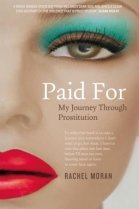
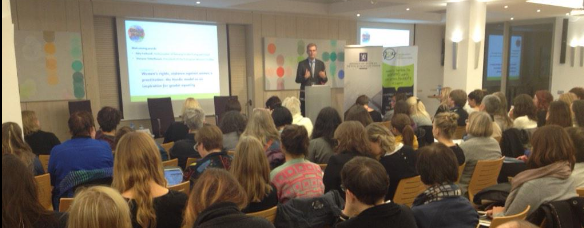
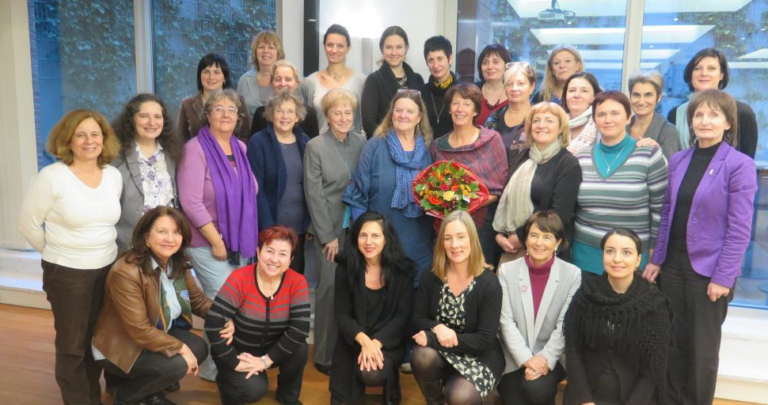
[Brussels, 23 July 2013] The European Women’s Lobby (EWL) is pleased to share this article with you, which presents the book of Rachel Moran “Paid For: My Journey Through Prostitution”. Rachel Moran is a survivor of prostitution and has been a speaker at the EWL’s side event on “Prostitution and violence against women: protection women’s rights in Europe and worldwide“, on 6 March 2013 in New York, during the 57th session of the Commission on the Status of Women. Rachel Moran works closely with the Irish NGOs dedicated to the abolition of the system of prostitution, such as Ruhama and the coalition Turn Off the Red Light. She has a blog theprostitutionexperience.com.
paid for rachel moran
Paid For: My Journey Through Prostitution, by Rachel Moran
A brave account of seven years as a prostitute makes harrowing reading, but it also shines with compassion and humanityby Susan McKay, published in the Irish Times, on 11 May 2013
Rachel Moran’s extraordinary book lays bare the seven years she spent as a prostitute. It took her more than a decade to write, looking back with clear eyes into the hell from which she had escaped. A blend of political analysis and memoir, this is at once an indictment of Ireland’s tolerance of violent sexual enslavement and a remarkable woman’s celebration of the survival of body, soul and passionate sexuality. It is a book about brutality by a writer of great sensitivity.
Like other exceptional individuals before her, Moran has bravely forfeited her anonymity to describe a life almost ruined by sexual violence, the better to insist that such violence must be stopped. She candidly admits that if she had been able to foresee her future when she was 14, she might well have killed herself. That was the age she was when she first stepped into a car on Benburb Street in Dublin, her then boyfriend urging the driver, a bespectacled and balding man in his 40s, “Take it easy: it’s her first time.”
The man paid her more than the going rate to “pull his prick with one hand, while leathering the arse off him with a thin, flexible branch”. She found that men who liked to be dominated were likely to be less dangerous than those who took their pleasure in overtly inflicting pain.
Whether the prostitute is required to be a dominatrix or a submissive, however, the man is in control. Moran’s graphic descriptions of what men demand from prostitutes are harrowing reading. She comments that a prostitute needs a “strong stomach”, and the book is replete with extremely disturbing material. There is semen, there is shit, there is blood. She quotes Andrea Dworkin, that most maligned of feminists: “Prostitution is not an idea. It is the mouth, the vagina, the rectum, penetrated usually by a penis, sometimes hands, sometimes objects, by one man and then another and then another and then another and then another.”
Moran tells chilling stories of women destroyed. One of them is so badly beaten that she takes to heroin and changes rapidly from a slim girl to a walking skeleton, chain-smoking, with “a vacant empty stare in her eyes”. Another agrees to perform a strip show and then service individually a group of men celebrating a sports event at a hotel – except they don’t stick to the terms agreed. “I never met the girl who left that night again, though I spent several years in touch with the one who arrived back the next morning.”
There is no solidarity with the clients, nothing to remind the prostitute of their shared humanity. Moran comments bleakly that the closest a prostitute will get “to understanding anything of a client’s family life is by noticing a baby seat in the back of his car or feeling the cold metal of his wedding ring pressed against the inner walls of her vagina”. Moran notes that men from Ireland are among those who travel to countries such as Thailand to rape children even younger than those they can find at home.
Her own childhood primed her for prostitution. Her parents both had serious mental illnesses that, in the Ireland of the 1970s and 1980s, they had to treat themselves, with drugs they became addicted to. The family was acutely poor. In the working-class Dublin housing estate where they lived, they were called knackers. “Our lives as children set us utterly apart from mainstream society and we were raised both painfully aware of it and numbly accepting of it,” she writes.
This mode enables people with epilepsy to use the website safely by eliminating the risk of seizures that result from flashing or blinking animations and risky color combinations.
Visually Impaired Mode
Improves website's visuals
This mode adjusts the website for the convenience of users with visual impairments such as Degrading Eyesight, Tunnel Vision, Cataract, Glaucoma, and others.
Cognitive Disability Mode
Helps to focus on specific content
This mode provides different assistive options to help users with cognitive impairments such as Dyslexia, Autism, CVA, and others, to focus on the essential elements of the website more easily.
ADHD Friendly Mode
Reduces distractions and improve focus
This mode helps users with ADHD and Neurodevelopmental disorders to read, browse, and focus on the main website elements more easily while significantly reducing distractions.
Blindness Mode
Allows using the site with your screen-reader
This mode configures the website to be compatible with screen-readers such as JAWS, NVDA, VoiceOver, and TalkBack. A screen-reader is software for blind users that is installed on a computer and smartphone, and websites must be compatible with it.
Online Dictionary
Readable Experience
Content Scaling
Default
Text Magnifier
Readable Font
Dyslexia Friendly
Highlight Titles
Highlight Links
Font Sizing
Default
Line Height
Default
Letter Spacing
Default
Left Aligned
Center Aligned
Right Aligned
Visually Pleasing Experience
Dark Contrast
Light Contrast
Monochrome
High Contrast
High Saturation
Low Saturation
Adjust Text Colors
Adjust Title Colors
Adjust Background Colors
Easy Orientation
Mute Sounds
Hide Images
Hide Emoji
Reading Guide
Stop Animations
Reading Mask
Highlight Hover
Highlight Focus
Big Dark Cursor
Big Light Cursor
Cognitive Reading
Virtual Keyboard
Navigation Keys
Voice Navigation
Accessibility Statement
womenlobby.org
18 March 2026
Compliance status
We firmly believe that the internet should be available and accessible to anyone, and are committed to providing a website that is accessible to the widest possible audience,
regardless of circumstance and ability.
To fulfill this, we aim to adhere as strictly as possible to the World Wide Web Consortium’s (W3C) Web Content Accessibility Guidelines 2.1 (WCAG 2.1) at the AA level.
These guidelines explain how to make web content accessible to people with a wide array of disabilities. Complying with those guidelines helps us ensure that the website is accessible
to all people: blind people, people with motor impairments, visual impairment, cognitive disabilities, and more.
This website utilizes various technologies that are meant to make it as accessible as possible at all times. We utilize an accessibility interface that allows persons with specific
disabilities to adjust the website’s UI (user interface) and design it to their personal needs.
Additionally, the website utilizes an AI-based application that runs in the background and optimizes its accessibility level constantly. This application remediates the website’s HTML,
adapts Its functionality and behavior for screen-readers used by the blind users, and for keyboard functions used by individuals with motor impairments.
If you’ve found a malfunction or have ideas for improvement, we’ll be happy to hear from you. You can reach out to the website’s operators by using the following email
Screen-reader and keyboard navigation
Our website implements the ARIA attributes (Accessible Rich Internet Applications) technique, alongside various different behavioral changes, to ensure blind users visiting with
screen-readers are able to read, comprehend, and enjoy the website’s functions. As soon as a user with a screen-reader enters your site, they immediately receive
a prompt to enter the Screen-Reader Profile so they can browse and operate your site effectively. Here’s how our website covers some of the most important screen-reader requirements,
alongside console screenshots of code examples:
Screen-reader optimization: we run a background process that learns the website’s components from top to bottom, to ensure ongoing compliance even when updating the website.
In this process, we provide screen-readers with meaningful data using the ARIA set of attributes. For example, we provide accurate form labels;
descriptions for actionable icons (social media icons, search icons, cart icons, etc.); validation guidance for form inputs; element roles such as buttons, menus, modal dialogues (popups),
and others. Additionally, the background process scans all the website’s images and provides an accurate and meaningful image-object-recognition-based description as an ALT (alternate text) tag
for images that are not described. It will also extract texts that are embedded within the image, using an OCR (optical character recognition) technology.
To turn on screen-reader adjustments at any time, users need only to press the Alt+1 keyboard combination. Screen-reader users also get automatic announcements to turn the Screen-reader mode on
as soon as they enter the website.
These adjustments are compatible with all popular screen readers, including JAWS and NVDA.
Keyboard navigation optimization: The background process also adjusts the website’s HTML, and adds various behaviors using JavaScript code to make the website operable by the keyboard. This includes the ability to navigate the website using the Tab and Shift+Tab keys, operate dropdowns with the arrow keys, close them with Esc, trigger buttons and links using the Enter key, navigate between radio and checkbox elements using the arrow keys, and fill them in with the Spacebar or Enter key.Additionally, keyboard users will find quick-navigation and content-skip menus, available at any time by clicking Alt+1, or as the first elements of the site while navigating with the keyboard. The background process also handles triggered popups by moving the keyboard focus towards them as soon as they appear, and not allow the focus drift outside it.
Users can also use shortcuts such as “M” (menus), “H” (headings), “F” (forms), “B” (buttons), and “G” (graphics) to jump to specific elements.
Disability profiles supported in our website
Epilepsy Safe Mode: this profile enables people with epilepsy to use the website safely by eliminating the risk of seizures that result from flashing or blinking animations and risky color combinations.
Visually Impaired Mode: this mode adjusts the website for the convenience of users with visual impairments such as Degrading Eyesight, Tunnel Vision, Cataract, Glaucoma, and others.
Cognitive Disability Mode: this mode provides different assistive options to help users with cognitive impairments such as Dyslexia, Autism, CVA, and others, to focus on the essential elements of the website more easily.
ADHD Friendly Mode: this mode helps users with ADHD and Neurodevelopmental disorders to read, browse, and focus on the main website elements more easily while significantly reducing distractions.
Blindness Mode: this mode configures the website to be compatible with screen-readers such as JAWS, NVDA, VoiceOver, and TalkBack. A screen-reader is software for blind users that is installed on a computer and smartphone, and websites must be compatible with it.
Keyboard Navigation Profile (Motor-Impaired): this profile enables motor-impaired persons to operate the website using the keyboard Tab, Shift+Tab, and the Enter keys. Users can also use shortcuts such as “M” (menus), “H” (headings), “F” (forms), “B” (buttons), and “G” (graphics) to jump to specific elements.
Additional UI, design, and readability adjustments
Font adjustments – users, can increase and decrease its size, change its family (type), adjust the spacing, alignment, line height, and more.
Color adjustments – users can select various color contrast profiles such as light, dark, inverted, and monochrome. Additionally, users can swap color schemes of titles, texts, and backgrounds, with over seven different coloring options.
Animations – person with epilepsy can stop all running animations with the click of a button. Animations controlled by the interface include videos, GIFs, and CSS flashing transitions.
Content highlighting – users can choose to emphasize important elements such as links and titles. They can also choose to highlight focused or hovered elements only.
Audio muting – users with hearing devices may experience headaches or other issues due to automatic audio playing. This option lets users mute the entire website instantly.
Cognitive disorders – we utilize a search engine that is linked to Wikipedia and Wiktionary, allowing people with cognitive disorders to decipher meanings of phrases, initials, slang, and others.
Additional functions – we provide users the option to change cursor color and size, use a printing mode, enable a virtual keyboard, and many other functions.
Browser and assistive technology compatibility
We aim to support the widest array of browsers and assistive technologies as possible, so our users can choose the best fitting tools for them, with as few limitations as possible. Therefore, we have worked very hard to be able to support all major systems that comprise over 95% of the user market share including Google Chrome, Mozilla Firefox, Apple Safari, Opera and Microsoft Edge, JAWS and NVDA (screen readers).
Notes, comments, and feedback
Despite our very best efforts to allow anybody to adjust the website to their needs. There may still be pages or sections that are not fully accessible, are in the process of becoming accessible, or are lacking an adequate technological solution to make them accessible. Still, we are continually improving our accessibility, adding, updating and improving its options and features, and developing and adopting new technologies. All this is meant to reach the optimal level of accessibility, following technological advancements. For any assistance, please reach out to