Gender-mainstreaming in EU climate policies
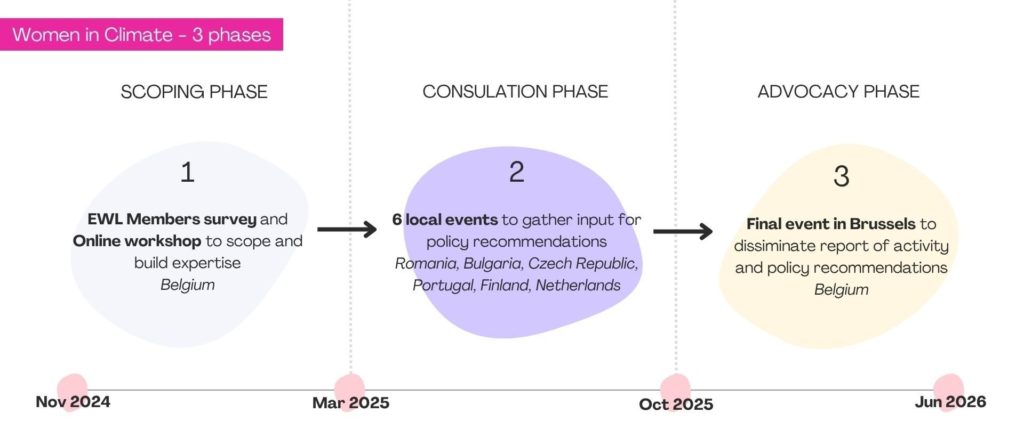
The Women in Climate project is a two-year initiative led by EWL and funded by the EU CERV programme, with national partners in six countries: Romania, Bulgaria, the Netherlands, Portugal, Finland, and the Czech Republic.
Our aim is to mainstream gender in EU climate policies, using a bottom-up approach, starting from local knowledge and activism and moving toward EU-level advocacy.
The project addresses the need for an intersectional perspective on the subject by ensuring the participation of women from diverse and marginalised backgrounds in all activities of the projects. All events are open to the public.
Key Activities and Progress so far
1. Pan-European Survey
We began with an online survey targeting EWL members across Europe. The aim was to map the existing knowledge of our members in gender and climate advocacy in order to involve them in the next steps of the project, and to identify the key barriers and opportunities in bringing a gender lens to climate policy.
- Reached participants in 11 countries, including EU-wide organisations
- Identified key challenges: lack of gender-sensitive policy, funding gaps, limited data
- Highlighted opportunities in inclusive infrastructure, gender budgeting, and climate-responsive healthcare
- We also collected over 15 expert contacts and 15 tools and resources, now informing the next project phases
By collecting data, resources, and expert contacts, we created momentum within our network and made sure the project was built on real needs and shared knowledge.
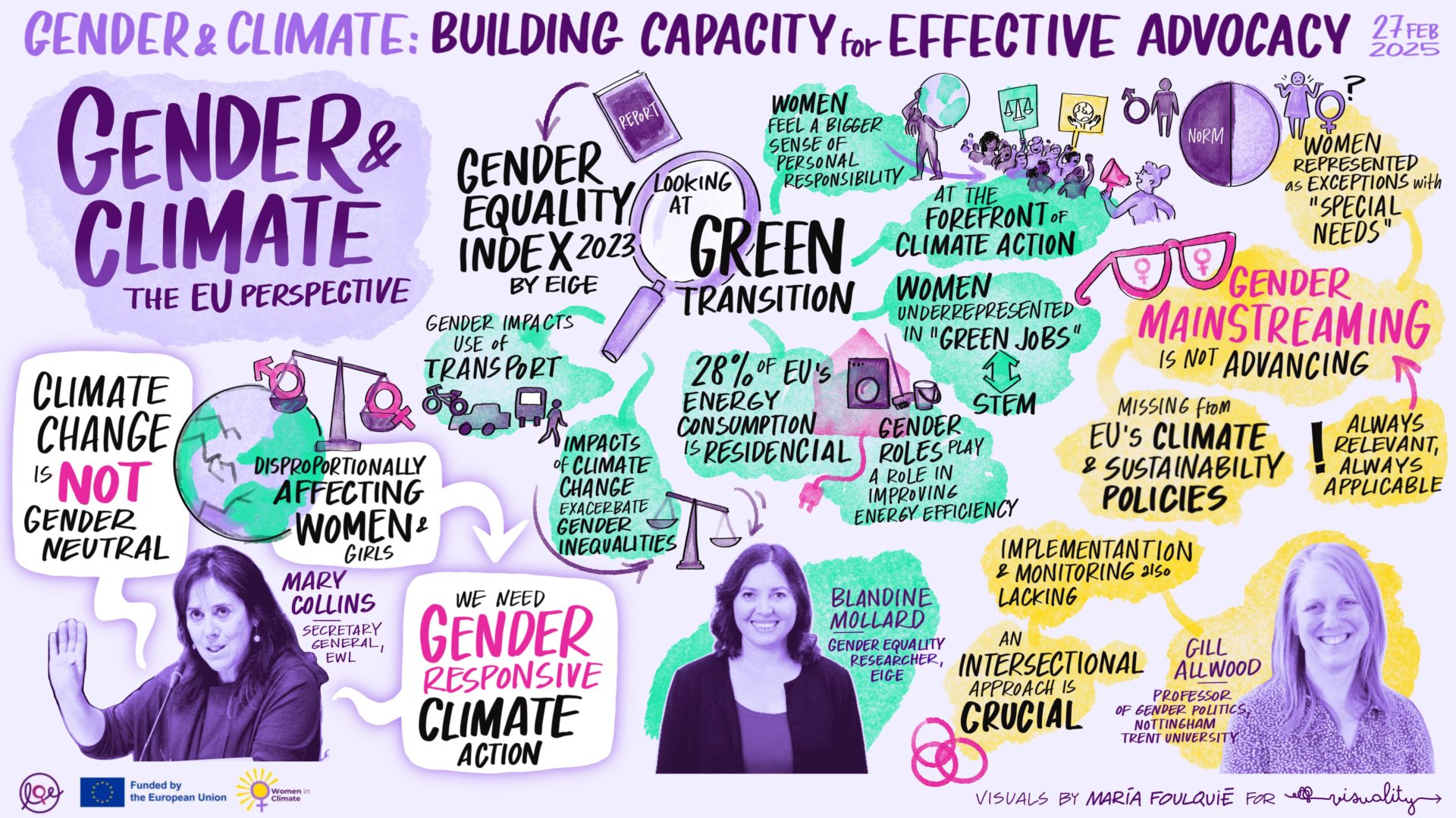
2. EU-Level Webinar on Feminist Climate Advocacy
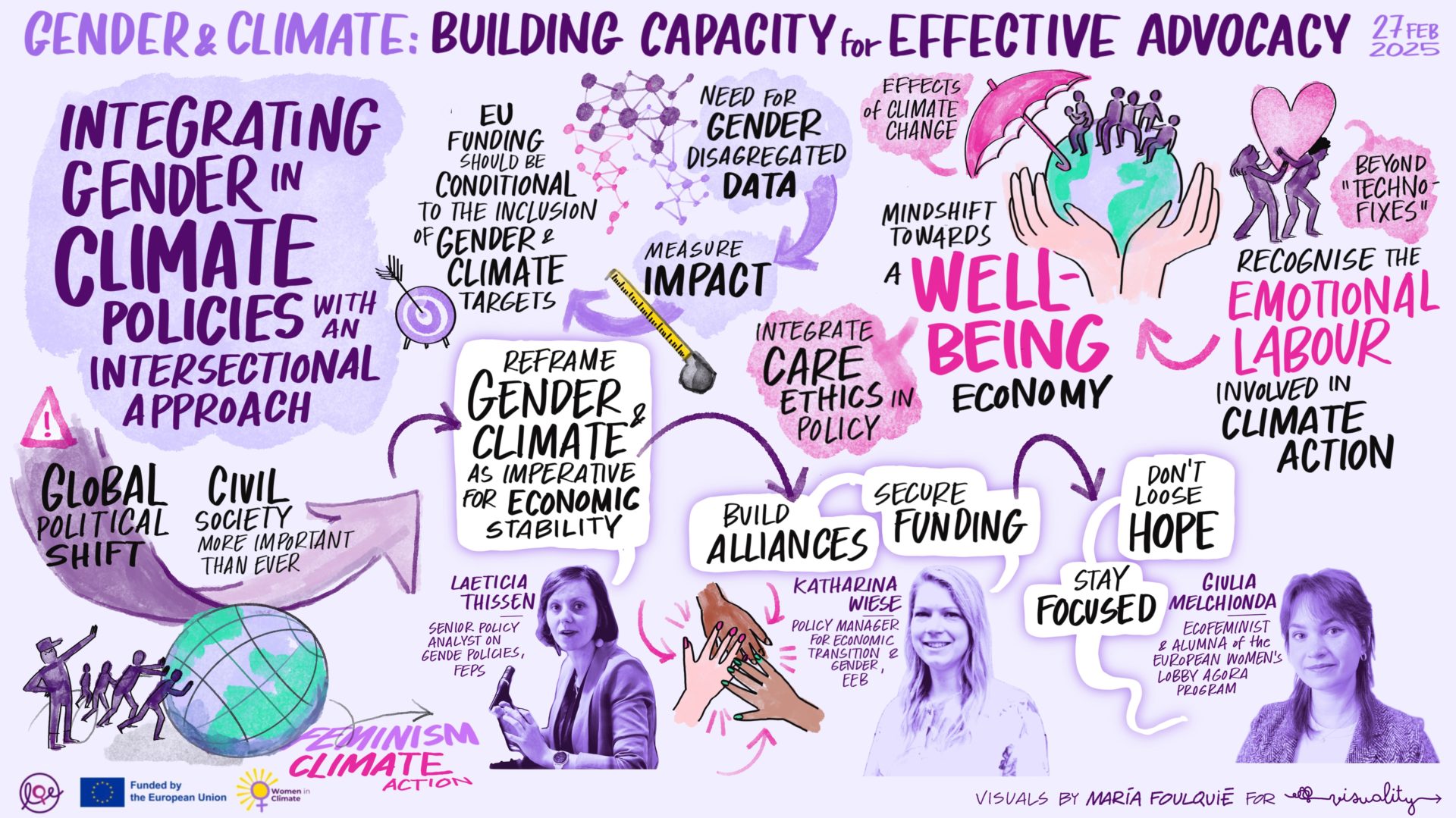
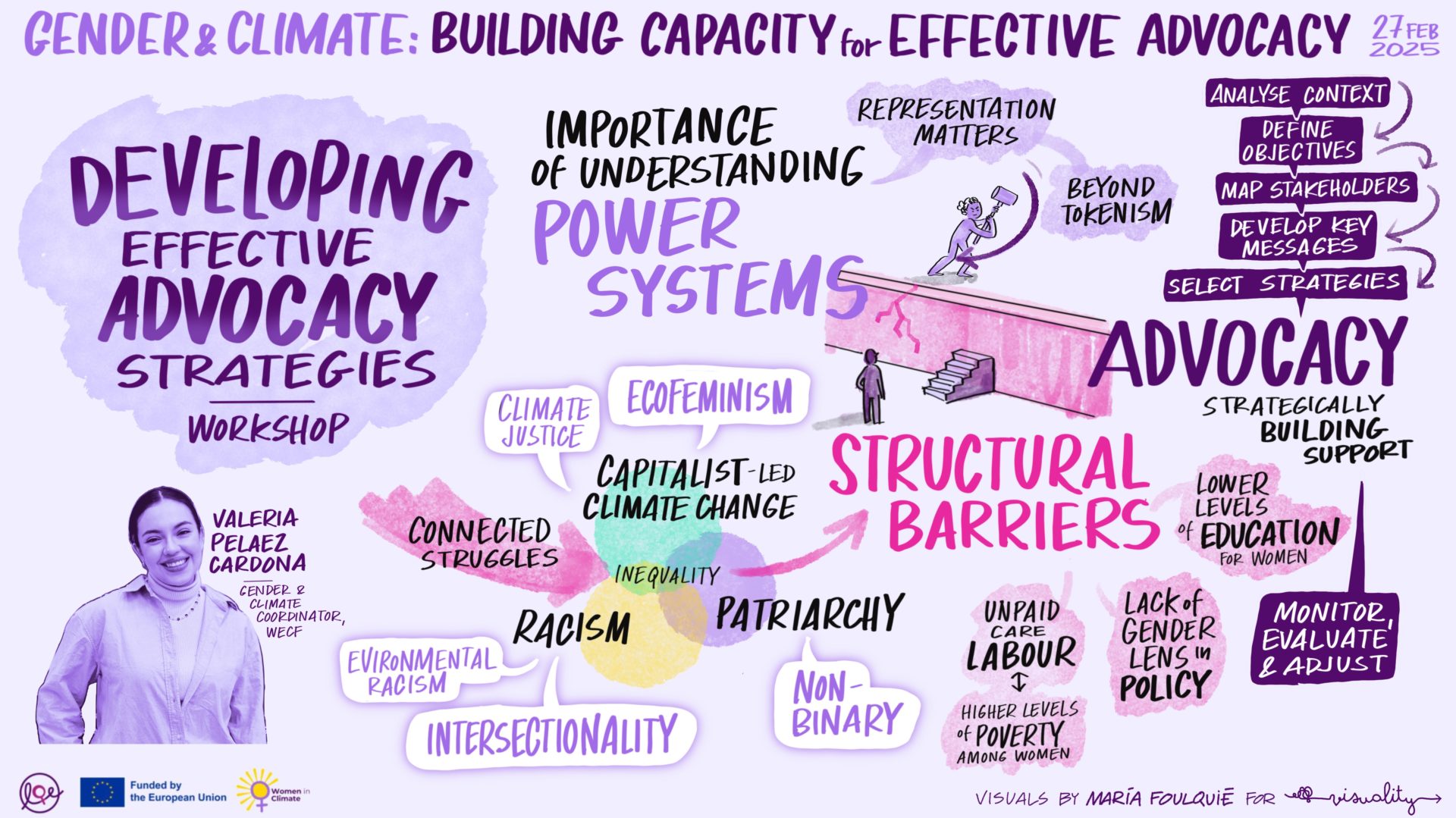
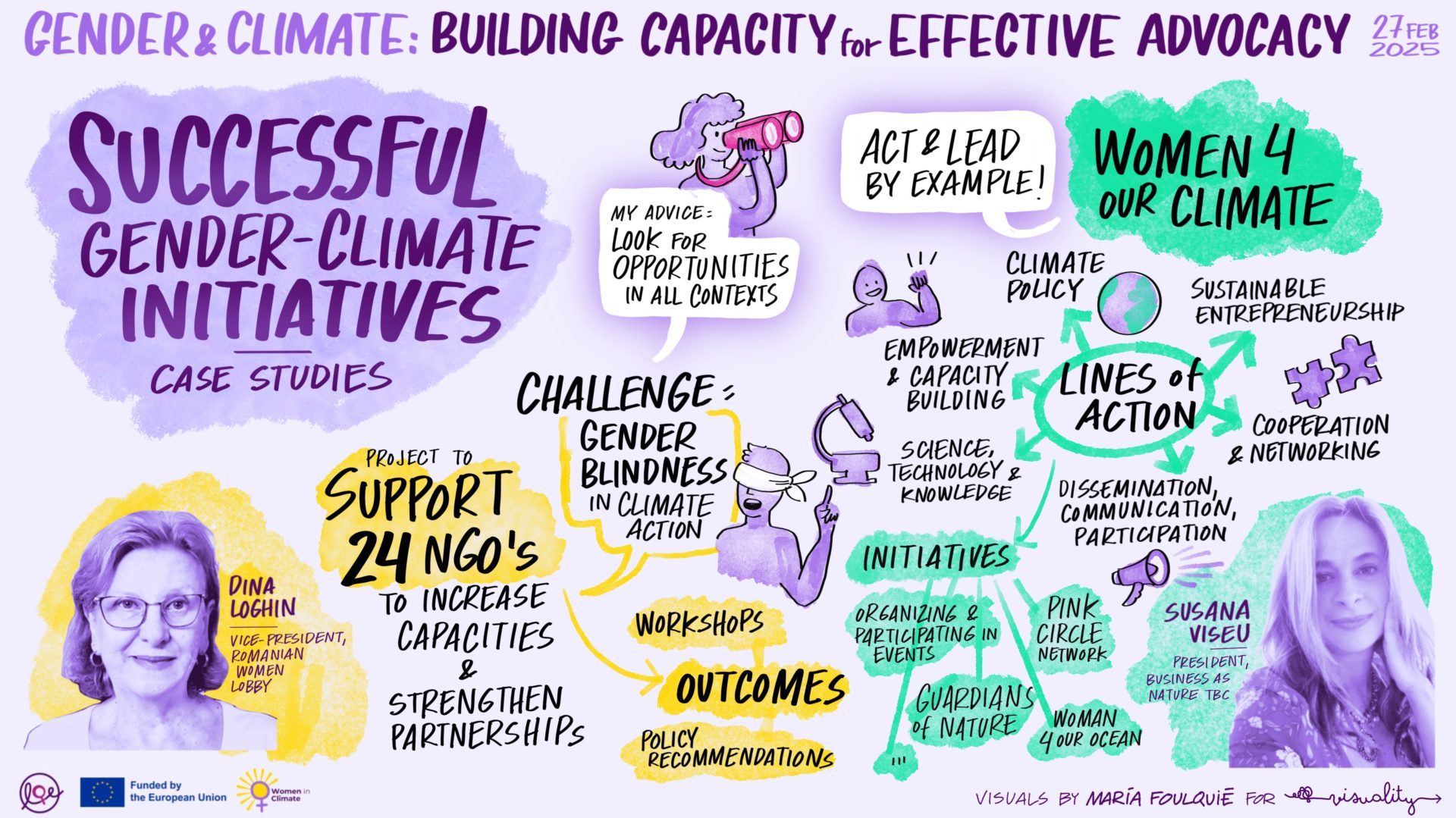
Our second milestone was a high-level webinar designed to build capacity, connect sectors, and shape advocacy strategies.
The 4h webinar featured keynote speeches, panel discussions, interactive workshops, and insightful case studies.
It included speakers from grassroots organisations, civil society, academia, and EU agencies, bringing a wide range of perspectives to the table.
Participants gave positive feedback, highlighting the diverse and intersectional expertise of the speakers, which helped make the connections between climate and gender feel both real and relevant.
3. Local Event in Romania – “No Solution Without Women”
We also had our first local event in May, led by our national partner in Romania. Its core aim was to highlight women’s voices and leadership in climate action, especially from underrepresented groups such as rural women, the elderly, Roma communities, and youth.
- It brought together 44 participants from diverse sectors, including local activists, local authorities, and feminist organisations.
- The event combined expert-led discussions with thematic working groups, allowing participants to explore concrete intersections between gender and climate policy.
- Participants identified key challenges, including gender-blind climate policies in Romania, and made strong recommendations around resilience, data, and representation.
Feedback highlighted the value of inclusive, cross-sectoral dialogue, and there was a clear call for more time and more frequent opportunities for these exchanges.
4. Local Event in Bulgaria - "Women and Climate Change"
On August 29th, our Bulgarian national partner organised the conference “Women and Climate Change” in Ravda.
The conference brought together women’s rights advocates, environmental experts, local authorities, and international representatives from partner organisations across Europe. Participants explored the gendered impacts of climate change through a programme combining keynote presentations, policy discussions, and thematic exchanges.
Discussions focused on three main themes: the impact of climate change on women’s health, the role of local authorities in climate adaptation, and the importance of equality policies in responding to the climate crisis. Speakers highlighted the need for gender-sensitive climate strategies, stronger cooperation between institutions and civil society, and more inclusive decision-making processes at local and European level.
5. Local Event in Czechia - "Equality and Climate: Gender Aspects of the Climate Crisis"
On September 3rd, our Czech national partner organised the conference “Equality and Climate: Gender Aspects of the Climate Crisis” in Prague.
The programme combined panel discussions and interactive workshops addressing the intersections between gender, climate justice, and social transformation. Participants explored why feminist climate justice is needed in the Czech context, and discussed how national and EU climate and environmental policies can better respond to the needs of different social groups. Discussions also focused on the gendered dimensions of the green transition, including its impact on education, employment, and career pathways.
A dedicated workshop on gender, climate, and green transformation encouraged participants to reflect on future career choices and the social implications of environmental change. Throughout the event, participants highlighted the importance of inclusive policymaking, equal representation in climate governance, and stronger cooperation between feminist and environmental movements.
6. Local Event in Portugal - "Women & Climate: The Voice and Action of Women for a Green Transition"
On September 19th, the Portuguese Platform for Women’s Rights (PpDM) organised the national event “Women & Climate: The Voice and Action of Women for a Green Transition” in Coimbra, in partnership with Business as Nature (BasN) and co-organised by the Municipality of Coimbra.
The morning conference, “For a Green Transition with Equality: Recommendations for Portugal and Europe”, focused on the findings of a survey conducted within the project, with particular attention to the Portuguese context. Discussions highlighted legislative gaps, priority areas for action, and examples of innovative and inclusive practices. Participants examined the differentiated impacts of climate change on women and girls, especially those in vulnerable situations, and emphasised the importance of embedding equality considerations into public policy at both national and European level.
In the afternoon, the event hosted the National Meeting of the Guardians of Nature Network, an initiative recognising the essential role of women in biodiversity conservation, sustainable rural development, and community-based climate solutions. The discussions highlighted the value of local knowledge, collective action, and women’s leadership in shaping resilient and sustainable environmental responses.
7. Local Event in Finland - "Equality and Climate in Times of Crisis - Towards Inclusive Climate Policy in Europe"
On September 29th, the Coalition of Finnish Women’s Associations NYTKIS, together with Rusetti ry and Plan Suomi International, organised the discussion event “Equality and Climate in Times of Crisis – Towards Inclusive Climate Policy in Europe” in Helsinki.
The aim was to spark constructive dialogue on how gender equality and the climate crisis are interconnected, and to identify concrete solutions for more just and inclusive climate policies.
Held in Finnish with Finnish Sign Language interpretation, the event also emphasised accessibility and inclusive participation.
8. Local Event in the Netherlands - "Voices of Change: Women & Climate Leadership"
On November 3rd, the Dutch Women’s Council (NVR) organised the conference “Voices of Change: Women & Climate Leadership” in The Hague.
- Discussions focused on the underrepresentation of women in climate decision-making, particularly in sectors linked to the green transition such as ICT, AI, energy, and transport.
- Participants highlighted the risks of excluding women from climate leadership and stressed the importance of inclusive and representative policymaking.
Discover more about our final event, organised at the European Economic and Social Committee on June 4, 2026.