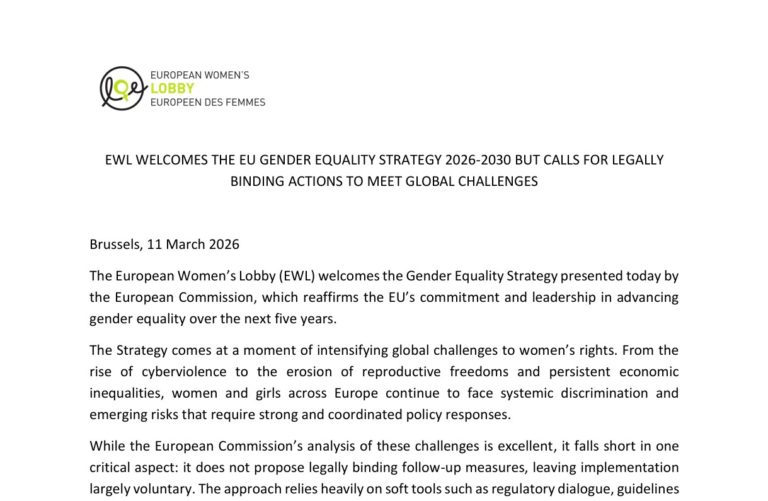
The European Women’s Lobby submitted detailed recommendations across all policy areas ahead of the new Gender Equality Strategy 2026–2030. The resulting Strategy picks up a significant number of these calls, spanning every pillar of EWL’s advocacy, from violence prevention to economic justice, from institutional reform to external action.
The Strategy delivers several advances. It establishes health as a standalone pillar for the first time in any EU gender equality framework. The Strategy acknowledges menstrual and menopause poverty, also as a first, launches a new WHO initiative on women’s healthcare, and includes SRHR data collection. The Commission’s formal acknowledgement that ESF+ funds may support access to abortion services, in response to the My Voice, My Choice ECI, is a historic first step. Care cannot be separated from health. The Strategy responds to a central EWL demand by committing to a European Care Deal by 2027, alongside implementation reports on the Work-Life Balance Directive and Council Recommendations on childcare and long-term care.
On violence against women, the Strategy commits to supporting transposition of the Violence Against Women Directive, strengthens the EU response to cyberviolence through investigations into Grok and VLOP pornographic platforms, trusted flagger guidelines, and cross-border cooperation, and reiterates the call to implement the Istanbul Convention. On equal pay and economic empowerment, it supports Pay Transparency Directive implementation with a joint EIGE toolkit on gender-neutral job evaluation, introduces gender-smart targets in funding programmes, supports women-led businesses through the European Competitiveness Fund, and includes a Council Recommendation on housing inequality with an intersectional approach.
These economic gains must be matched by structural change in the labour market. The Strategy introduces sector-specific initiatives EWL called for, an Action Plan for Women in Research, Innovation and Startups; a Women in Farming platform; the EU Artists’ Charter addressing cultural sector inequalities; a “Boys in HEAL” approach to occupational desegregation; gender-responsive measures in defence and transport; and references to the AI Act’s obligations on algorithmic discrimination in hiring. In education, the Strategy includes a Girls Go STEM initiative, support for teachers on challenging gender stereotypes, and sports gender mainstreaming through the European Week of Sport and Erasmus+ Sport.
On political participation, the Strategy includes a Recommendation on safety in politics, AgoraEU funding for women organisations, and a study on online narratives targeting young men and boys. On institutional mechanisms, EWL welcomes gender mainstreaming in the next MFF with budget tracking guidance; however, the EWL supports a more pro-active gender budgeting mechanism. The Recommendation on equality data, national gender equality action plans by 2027, support for Directives on Standards for Equality Bodies, and CERV and AgoraEU funding for feminist civil society. Finally, on external action, the launch of SHIELD, the renewal of GAP IV, and the new Women, Peace and Security Action Plan mark meaningful advances in the EU’s external gender commitments, and all directly respond to EWL demands.
Download the full analysis of the Gender Equality Strategy 2026-2030 here